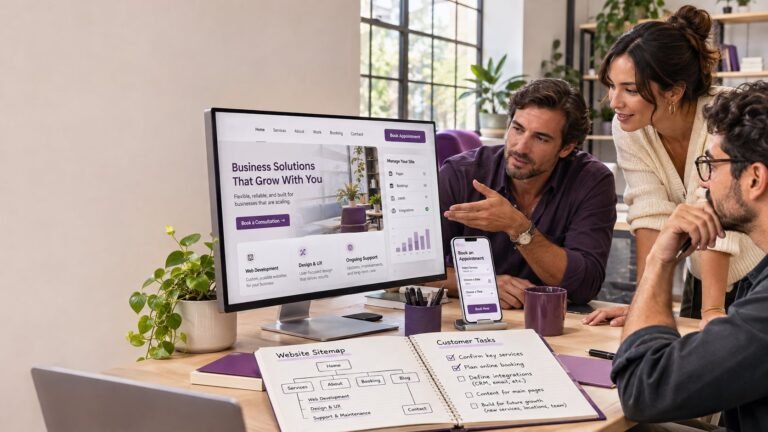

WordPress website development costs vary because businesses need different designs, content, features, and levels of support. A small brochure website has a different scope from a growing ecommerce site or a custom platform connected to business systems.
A useful estimate depends on a clear project scope. Before comparing quotes, list what the website needs to accomplish, what content is ready, which features are essential, and who will manage the site after launch.
What affects the cost of a WordPress website?
Website structure and page count
A website with a few standard pages generally has a different scope from one with many service categories, product pages, locations, or resource sections. Unique page layouts and complex content requirements can also affect planning and development work.
Consider what each page needs to do. Some pages may share a template, while others may need a distinct layout or functionality.
Design and customization
A project might use a configured theme, customize an existing design, or include more tailored design work. The choice affects the project scope and should reflect the company’s brand, customer needs, and content.
Ask which pages receive custom design and how many review rounds are included. Clear expectations help avoid confusion later in the project.
Content and media
The project may include writing, editing, photography, illustrations, or product data. If the business supplies content, decide who will prepare it, review it, and approve it.
Incomplete content can delay development or launch. Include content responsibilities and timing in the project plan.
Plugins, features, and integrations
Features such as online payments, appointment booking, customer accounts, product filtering, and custom forms can add setup, development, and testing work.
Integrations may also involve subscription fees or ongoing support. Ask what each tool does, how it connects to the website, and who will manage it.
Hosting and ongoing support
The initial development cost is not the entire cost of running a website. Businesses should also consider hosting, domain renewal, software subscriptions, backups, technical maintenance, and future enhancements.
Ask what post-launch support includes, how requests are handled, and what services require separate payment.
Prioritize features for launch
One way to manage scope is to group requirements into three categories:
- Essential for launch: Needed for the website to serve its primary purpose.
- Planned next: Valuable improvements that can be added after the core site is working.
- Optional: Features that can wait until there is a clear need.
For example, a company may first need accurate service pages and a dependable inquiry process. A custom customer portal might be a later project if there is a demonstrated business requirement.
Compare proposals by deliverables
A quote should explain what the provider will deliver. Compare page scope, design work, content support, functionality, integrations, testing, launch assistance, training, and post-launch support.
Ask who owns the domain, hosting, website files, and third-party accounts after launch. Also clarify how changes to the scope will be priced and approved.
Evaluate the budget against business goals
A website project may be intended to improve inquiries, sales, bookings, customer information, or internal workflows. The expected result depends on the business and how the website is maintained, so avoid relying on guaranteed outcomes.
Instead, agree on the website’s goals and how you will review progress after launch. This gives the business a practical way to decide whether future improvements are worthwhile.
Frequently asked questions
Why do WordPress development quotes vary?
Providers may be estimating different page counts, design approaches, features, integrations, content work, and support. Compare the scope behind each quote.
Is a WordPress theme enough for a business website?
It can be, depending on the company’s requirements. Review the design, required features, editing needs, and long-term maintenance before choosing a setup.
What should we prepare before requesting an estimate?
Share your business goals, audience, existing website issues, required pages and features, available content, timeline, and known budget constraints.
A realistic WordPress budget starts with business priorities and an agreed project scope. Expert advice can help you understand which requirements should be included at launch and which can be planned for later.
Need help estimating your WordPress project? Get expert advice for your business to discuss your requirements and development budget.